
Soil, Not Blood
A newsletter where carbon, technology, and culture converge.


(Illustration by Walter McLeod/Gemini)
Issue No. 163
Happy Black History Month!
Welcome to the latest Carbon Creed - where carbon, technology, and culture converge.
In this issue, we focus on a paramount constitutional moment: the Supreme Court's upcoming hearing challenging the legality of birthright citizenship — a right forged in Reconstruction and written into the Fourteenth Amendment so that no child born on American soil could ever be rendered legally invisible. The discussion traces that hard-won guarantee and its roots in black history, making the case that the Court has the solemn obligation to uphold it.
We hope you enjoy the discussion!
Discussion
The Reconstruction Origins of Birthright Citizenship
There is a particular kind of courage embedded in the act of writing a constitutional amendment — not the courage of the battlefield, but the courage of precision: the deliberate choice to plant a flag in language so clear that no future court, no future demagogue, no future tide of nativism could wash it away. The men who drafted the Fourteenth Amendment understood that vague ideals had already failed Black Americans once. The Declaration of Independence had promised that all men were created equal, and yet four million people remained in chains. This time, Lincoln’s Republican allies resolved to be explicit. Soil, not blood. Geography, not genealogy. Where you are born, not to whom.
That resolution — forged in the crucible of Reconstruction and animated by the specific horror of what had been done to Black Americans — is now before the Supreme Court. When the justices hear oral arguments in Trump v. Barbara on April 1, they will be asked to rule on whether a president may, by executive order, strip birthright citizenship from children born on American soil to undocumented parents. The question sounds modern, even novel. But as constitutional scholar Akhil Reed Amar eloquently argues in the New York Times, the answer was written into the Constitution more than 150 years ago, in the blood and struggle of the Black freedom movement.
To understand what is truly at stake when the Court’s final ruling emerges this June, one must travel back to 1857, when the Supreme Court handed down one of the most morally catastrophic decisions in its history. In Dred Scott v. Sandford, Chief Justice Roger Taney proclaimed that no Black American descended from enslaved people could ever be a citizen. Citizenship, in Taney’s vision, was a matter of blood, of hereditary caste, of racial lineage — and it annihilated the legal personhood of millions.
This is the wound the Fourteenth Amendment was designed to close, surgically and permanently. By 1862, Lincoln’s Attorney General Edward Bates had already laid the groundwork, issuing a landmark opinion declaring that American citizenship rested on soil, not blood. “Every person born in the country,” Bates wrote, “is, at the moment of birth, prima facie a citizen — without any reference to race or color, or any other accidental circumstance.” Lincoln’s allies in Congress then embedded this principle into the Constitution itself: “All persons born or naturalized in the United States, and subject to the jurisdiction thereof, are citizens of the United States.”
The key word, as Amar notes, is the preposition in. Not to citizens of. Not to lawfully domiciled parents of. The text is silent on parentage — and that silence was entirely intentional. The amendment’s framers, having watched blood-based citizenship used to deny humanity to Black Americans for generations, wanted no rules that turned on who your parents were. They rehearsed their reasoning in a phrase that became almost a refrain: a child was a citizen if, on the day of its birth, American soil lay below and an American flag flew above. The test was geographic, concrete, and race-neutral. That was the point. That was the revolution.
The Supreme Court has already upheld this understanding once before, under pressure not unlike today’s. In its landmark 1898 decision United States v. Wong Kim Ark, the Court ruled that a child born in San Francisco to Chinese parents ineligible for citizenship was nonetheless a natural-born American. The Court held firm against intense nativist pressure, declaring that the Fourteenth Amendment meant precisely what it said. Congress reaffirmed this reading in statute in 1940 and again in 1952. For over a century, the matter has been considered settled — settled not merely by precedent, but by text, history, and the moral logic of Reconstruction itself.
The executive order now before the Court attempts to unsettle more than a century of settled law by importing a parentage requirement that the amendment’s framers explicitly refused to write. It asks the judiciary to make citizenship contingent on the legal status of one’s mother and father — to reason, in essence, like Roger Taney. The administration argues that children of undocumented immigrants are not truly “subject to the jurisdiction” of the United States, and therefore fall outside the amendment’s guarantee. But this reading contorts a phrase the Reconstruction Congress used to exclude only a narrow category of people — foreign diplomats, members of occupying armies — into a sweeping tool for denying citizenship to an entire class of babies born on American soil.
The current Court must reject it clearly and unequivocally. Anything less would represent a failure of constitutional stewardship with consequences that reach far beyond immigration policy. If the justices permit the executive branch to redefine birthright citizenship by decree — bypassing the amendment process, ignoring 125 years of precedent, and discarding the explicit intentions of the Reconstruction Congress — they will have sanctioned a model of governance in which constitutional guarantees are only as durable as the current administration’s tolerance for them. That is not the rule of law. That is its unraveling.
February is Black History Month, and it is fitting that this legal challenge arrives in its shadow. The story of birthright citizenship is, at its core, a story about Black Americans — about what it cost to establish that birth on this soil confers belonging, and why that principle was written in constitutional stone rather than left to political winds. The Fourteenth Amendment is Black history. It is American history. It is the legal monument to the abolitionists, the freedom fighters, and the Reconstruction legislators who demanded that America’s founding ideals be structurally transformed, not merely reaffirmed in sentiment.
When the justices rule this June, they will decide whether that hard-won clarity retains its force. The amendment’s framers stripped away every ambiguity, chose the word all, and said nothing — deliberately nothing — about parents. They did so because they had seen what happens when citizenship is made contingent on ancestry, on lineage, on the circumstances of one’s birth rather than the fact of it. They had seen four million human beings rendered legally invisible. They wrote the Fourteenth Amendment so that it could never happen again.
Poll
Book
The Carbon Creed
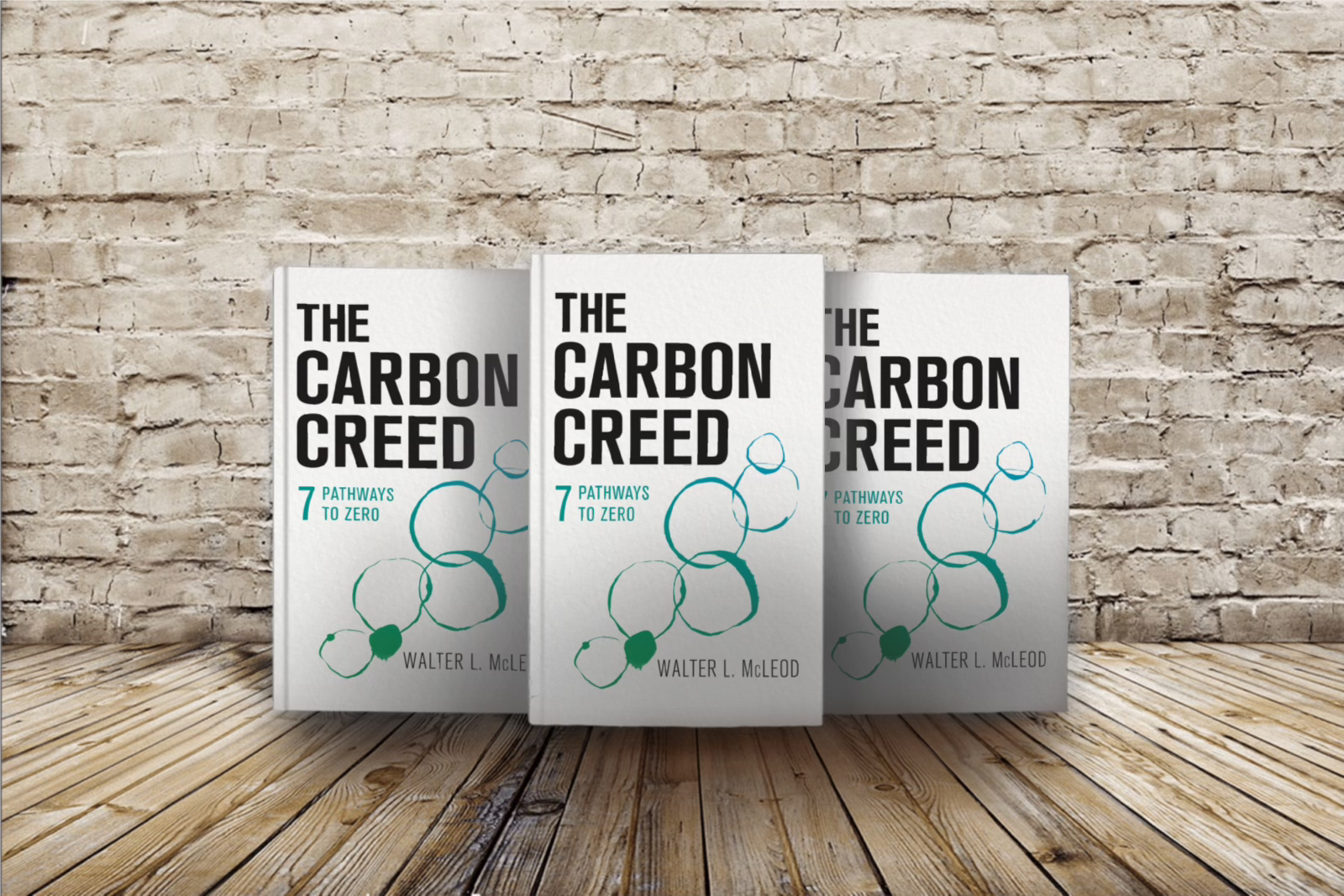
If you’ve been looking for a roadmap that is as practical as it is visionary, you’ve found it. The Carbon Creed isn’t just a book; it’s a manifesto for the next generation of business leaders, policymakers, and conscious citizens.
Cleantech evangelist McLeod moves beyond the “doom and gloom” of media headlines, offering a structured philosophy—a creed—to help you:
Navigate the complexities of the global energy transition.
Integrate sustainability into core business strategies.
Lead with integrity in a rapidly changing regulatory landscape.
Order your copy today and join the movement toward a sustainable future.
Video
SCOTUS Draws the Line
Why the Tariff Ruling Matters
In a landmark 6-3 decision issued on February 20, 2026, the Supreme Court struck down the bulk of President Trump's sweeping tariff program, ruling that he had exceeded his authority by using a 1977 emergency law — the International Emergency Economic Powers Act (IEEPA) — to impose import duties on goods from virtually every nation on earth. The ruling invalidates the so-called "reciprocal" tariffs as well as duties tied to fentanyl emergency declarations, though sector-specific tariffs on steel, aluminum, and autos remain in place under separate legal authority.
What makes this ruling significant beyond the economics is what it says about the constitutional order. The majority — a notably cross-ideological coalition — invoked the “major questions” doctrine, the principle that when a president claims authority to make decisions of enormous economic consequence, he must point to clear congressional authorization. The Tax Foundation estimates the IEEPA tariffs were on track to raise $1.4 trillion over the next decade and had already cost the average American household roughly $1,000 in 2025. Tax Foundation For the Court to step in, rebuke a popular president on his signature economic agenda, and do so with justices from both wings of the bench, reflects the judiciary functioning as a genuine check on executive power — not merely a rubber stamp.
Whether you support or oppose tariffs as a policy, the institutional lesson here is worth noting. The administration argued that emergency powers gave the president essentially unlimited latitude to reshape global trade on his own say-so. The Court disagreed, and did so in plain language. Trump has already announced plans to pursue new tariffs through other legal avenues, so the economic battle is far from over. But the constitutional principle the Court affirmed — that vast, economy-reshaping power requires explicit authorization from Congress, not creative statutory interpretation — is one that will outlast this particular trade dispute.
RESOURCES
Currents a podcast featuring in-depth discussions with experts on clean energy and finance, published by Norton Rose Fulbright.
Canary Media is an independent, nonprofit newsroom covering the transition to clean energy and solutions to the climate crisis
Thanks for reading Carbon Creed! Subscribe for free to receive new posts and support my work.