
Three Forces Reshaping Energy in 2026
The newsletter where energy, technology, and culture converge.

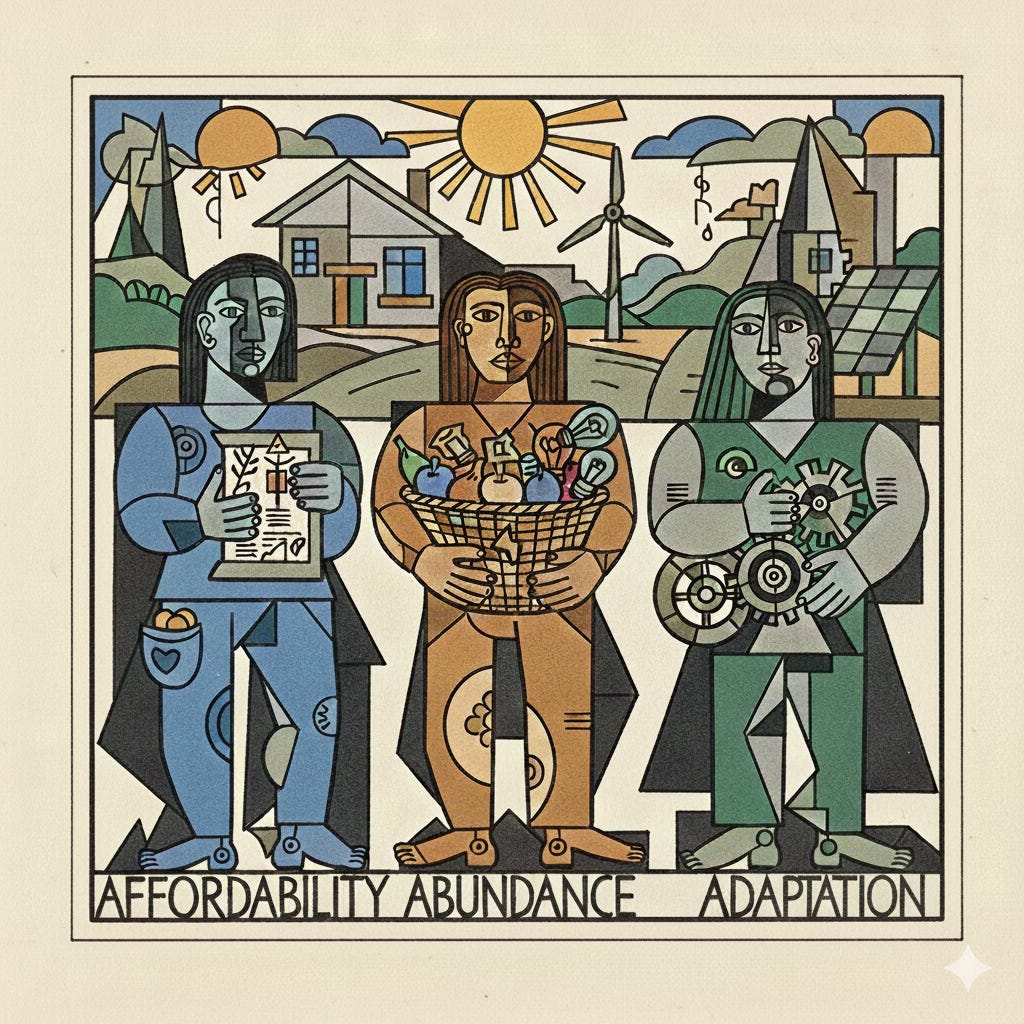
(Illustration by Walter McLeod/Gemini)
Issue No. 162
Happy New Year!
Welcome to the latest Carbon Creed - where energy, technology, and culture converge.
As we enter 2026, the energy landscape stands at an inflection point. After years dominated by climate targets and clean technology deployment, the energy sector is facing a massive reality check driven by expiring federal subsidies, a hungry AI sector, and a voter base that has lost its patience for high utility bills.
Three interconnected themes are emerging that will shape policy debates, investment decisions, and public discourse throughout the year: affordability, abundance, and adaptation.
We hope you enjoy the discussion!
Discussion
The New Energy Equation
Affordability: The Reckoning
The politics of electricity prices erupted into the mainstream during the November 2025 gubernatorial races in Virginia and New Jersey, along with the Georgia Public Service Commission elections. What had long simmered as a technical regulatory issue suddenly became a defining ballot box concern. Voters sent a clear message: they want to know who’s paying for the energy transition and why their bills keep climbing.
The irony is painful for many ratepayers. While solar and wind costs have plummeted and renewable energy sets generation records, residential electricity bills continue their upward march. The disconnect stems from a fundamental asymmetry in how costs and benefits flow through the system. Utilities spread the infrastructure investments required for grid modernization, transmission upgrades, and renewable integration across all ratepayers. Meanwhile, the direct financial benefits of lower-cost clean energy disproportionately accrue to data centers, hyperscalers, AI companies, and large institutional investors.
Middle-class households find themselves shouldering transition costs through higher rates while remaining tethered to a grid they’re told is becoming cheaper to operate. This growing burden on ratepayers will intensify as federal clean energy subsidies begin expiring. The Inflation Reduction Act’s production and investment tax credits provided crucial support for renewable deployment, but as these provisions sunset, the question becomes stark: will the industry stand on its own, or will costs shift even more dramatically to captive utility customers?
The affordability crisis will force uncomfortable conversations in 2026 about rate design, cost allocation, and whether the current utility regulatory model can deliver an equitable energy transition. Expect this issue to dominate state legislatures and public utility commission dockets throughout the year.
Abundance: The Paradigm Shift
The Abundance movement burst into national consciousness in 2025, crystallized by Ezra Klein and Derek Thompson’s book of the same name. At its core, abundance thinking rejects the scarcity mindset that has paralyzed American policy for decades. Instead of managing decline and rationing opportunity, the abundance agenda seeks to dramatically expand supply across housing, electricity, healthcare, and infrastructure.
For the energy sector, this means confronting the thicket of regulations, permitting delays, and veto points that make building anything in America extraordinarily difficult. While environmentalists spent years fighting new fossil fuel infrastructure, they inadvertently created procedural barriers that now obstruct clean energy deployment as well. Transmission lines languish in permitting purgatory for a decade. Renewable projects face endless litigation. Even replacing aging infrastructure becomes a bureaucratic nightmare. The question is whether policymakers recognize this self-inflicted paralysis.
There are signs that the federal government is responding. Efforts to streamline federal permitting for on-site and co-located generation at data centers represent a recognition that America’s artificial intelligence ambitions require abundant, reliable electricity. The old playbook of managing energy demand through efficiency and conservation cannot power the exponential compute requirements of AI training and inference. Data center operators need gigawatts of new generation, and they need it fast.
This regulatory streamlining for data centers could serve as a template for broader reform. If the federal government can expedite permitting when AI competitiveness is at stake, why can’t it do the same for transmission projects that would lower costs for all consumers, or for the factories needed to reshore critical manufacturing?
The abundance movement will test whether America can rediscover the state capacity that built the Interstate Highway System and the electrical grid itself. The alternative is continuing to be a nation that can no longer build.
Adaptation: The Emerging Imperative
Perhaps the most significant shift in 2026 will be the growing recognition that adaptation and resilience must become central to energy strategy, not afterthoughts to mitigation. This transition is being accelerated by the race for artificial intelligence dominance, which is causing government and corporate leaders to prioritize energy abundance and reliability over emissions reduction timelines.
This represents a maturation in how we think about climate policy, not an abandonment of mitigation efforts. We’re warming the planet, extreme weather events are intensifying, and energy systems need to function reliably despite these stresses. Pretending otherwise serves no one.
Low-carbon technologies remain essential to the energy transition, both for their climate benefits and increasingly for their economic advantages. But the frame is shifting from “we must decarbonize to prevent warming” to “we need resilient, affordable, low-carbon energy systems for a warming world.” Nuclear power, geothermal, advanced batteries, and renewables all fit within this paradigm as technologies that can deliver reliable electricity without emissions.
This is where artificial intelligence becomes not just a driver of electricity demand but a potential solution to cost challenges. AI applications are already optimizing grid operations, predicting renewable generation, accelerating materials discovery for batteries and solar cells, and improving the efficiency of everything from industrial processes to building energy management. If AI can dramatically reduce the costs of deploying and operating low-carbon technologies, it could help solve the affordability crisis while building more resilient systems.
The adaptation imperative will drive investment in grid hardening, distributed generation, microgrids, and energy storage. It will elevate reliability and resilience as first-order design criteria, not secondary considerations. And it will require honest conversations about the trade-offs between speed, cost, and emissions reductions.
The Convergence
These three themes don’t exist in isolation; they’re deeply intertwined. Affordability concerns stem partly from an inability to build abundant new supply quickly. The abundance agenda requires adaptation to new technologies and regulatory models. And adaptation strategies must be affordable to gain public support.
How these tensions resolve will determine whether America enters a new era of energy abundance and prosperity or continues muddling through with an increasingly expensive, unreliable, and inequitable system. The energy transition was always going to be more complex than simply swapping out fossil fuels for renewables. Now we’re confronting that complexity head-on.
The question for 2026 is whether our institutions—from state utility commissions to federal agencies to Congress itself—can move beyond incrementalism and turf protection to build the abundant, affordable, resilient energy systems that both economic competitiveness and climate adaptation demand.
Poll
Media
Abundance Is the Key to Fixing America
A Podcast by Scott Galloway
In this episode of Prof G Conversations, Scott Galloway, Ezra Klein, and Derek Thompson discuss the urgent need for a “pro-build” mindset to address America’s most pressing challenges. They argue that American policy has shifted from a culture of building to one of “blocking.” Over-regulation and NIMBYism (Not In My Backyard) have created artificial scarcity in housing, energy, and education. By prioritizing an Abundance Agenda, Klein and Thompson suggest that the government can solve the affordability crisis by focusing on tangible outcomes—such as lowering the cost of solar energy and increasing the housing supply—rather than just touting the amount of money spent on social programs.
Beyond addressing regulatory barriers, the discussion also highlights the decline of institutional ambition and the pitfalls of protectionist policies like tariffs that drive up the cost of living for everyday Americans. For a more effective future, the trio posits that political success will depend on outcome-based liberalism: a strategy centered on building quickly and efficiently to improve quality of life and restore faith in the government’s ability to serve its citizens.
RESOURCES
Currents a podcast featuring in-depth discussions with experts on clean energy and finance, published by Norton Rose Fulbright.
Canary Media is an independent, nonprofit newsroom covering the transition to clean energy and solutions to the climate crisis
Thanks, Walter!